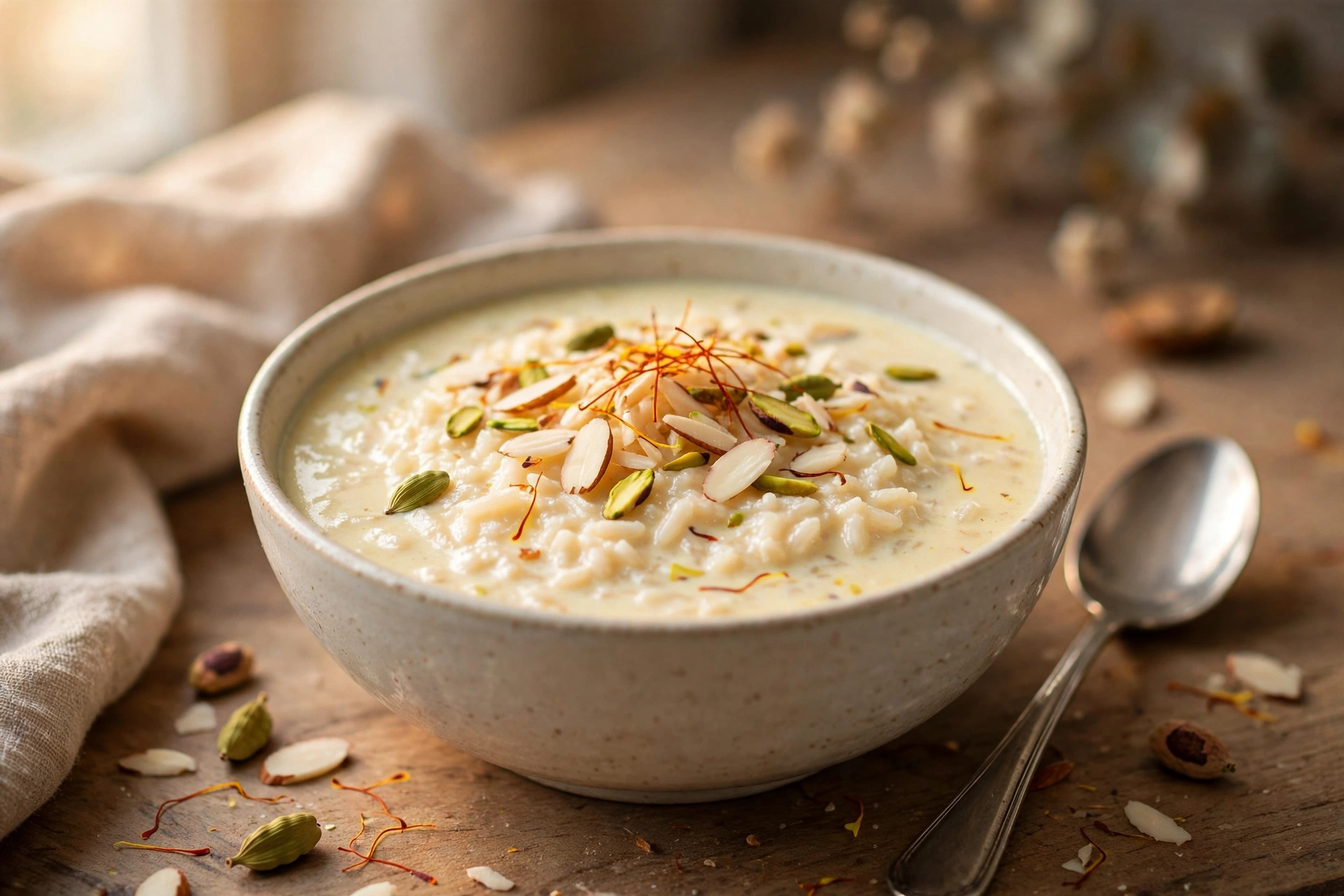
Rice Kheer Recipe: Creamy Cardamom Rice Pudding
Prep time: 10 minutes (plus 30 minutes soaking) Cook time: 45–50 minutes Servings: 6
Some desserts shout, and some desserts hum quietly. Kheer hums. It is the bowl that appears at the end of a family meal without any announcement, the one simmering patiently on the back of the stove while everything else is being cooked, filling the house with the soft perfume of cardamom and warm milk. In my family, kheer was never really a “special occasion” dessert — it was what my mother made when someone needed cheering up, or when guests dropped in unexpectedly.
The honest truth about kheer is that it cannot be rushed, and that is exactly its charm. The rice needs time to swell and soften, the milk needs time to reduce and turn silky, and you need to be nearby with a wooden spoon, stirring in that slow, meditative way. What you get for that patience is a pudding that is creamy without any cream, sweet without being cloying, and delicately fragrant with cardamom and rose. Serve it warm on a cold evening or chilled from the fridge in summer — it is two desserts in one, and both are wonderful.
Why You’ll Love This Recipe
- Creamy, luxurious texture using nothing but milk, rice, sugar and time — no cream or condensed milk needed.
- Gentle, real flavour: cardamom, a hint of rose, and the natural sweetness of reduced milk.
- One pot, five core ingredients, and a method that asks for patience rather than skill.
- Equally delicious warm or chilled, so it suits every season.
- A natural make-ahead dessert that actually improves after a night in the fridge.
Ingredients
- 1 litre (4 cups) full-cream milk — full-cream is important here; low-fat milk gives a thin kheer
- 60 g (1/3 cup) basmati rice
- 80–100 g (about 1/2 cup) granulated sugar, adjusted to your taste
- 6 green cardamom pods, seeds removed and crushed to a powder (or 1/2 teaspoon ground cardamom)
- 1 teaspoon rose water (optional)
- 2 tablespoons chopped almonds and pistachios, plus extra to serve
- A small pinch of saffron strands soaked in 2 tablespoons warm milk (optional, but beautiful)
- A tiny pinch of salt — it quietly deepens the sweetness
Instructions
- Soak the rice. Rinse the basmati rice under cold water two or three times until the water runs mostly clear. Cover with fresh water and soak for 30 minutes, then drain. Soaking helps the grains cook evenly and start breaking down into that creamy texture. For an even creamier kheer, lightly crush the drained rice with your fingers or the back of a spoon so most grains are broken in half.
- Start the milk. Pour the milk into a heavy-bottomed pot — a heavy base matters, because milk loves to catch and scorch. Bring it to a gentle boil over medium heat, stirring from time to time.
- Add the rice. Once the milk is boiling, add the drained rice and stir well. Reduce the heat to low-medium, so the milk simmers steadily without boiling over.
- Simmer and stir. Cook for 40–45 minutes, stirring every few minutes and scraping the bottom and sides of the pot each time. The milk will slowly reduce, thicken and turn a warmer, creamier colour. The rice grains will soften and begin to melt into the milk. As the kheer thickens, stir more often — the last ten minutes are when it is most likely to catch.
- Check the texture. The kheer is ready when the rice is completely soft and the pudding coats the back of a spoon. Remember that it will continue to thicken as it cools, so take it off the heat when it looks just slightly thinner than you want it to be. If it ever gets too thick, a splash of warm milk brings it right back.
- Sweeten and flavour. Stir in the sugar and the pinch of salt, and cook for another 3–4 minutes until the sugar dissolves and the kheer comes back to a simmer. (Sugar goes in near the end — adding it too early can stop the rice from softening properly.) Stir in the crushed cardamom, the rose water, the saffron milk if using, and the chopped nuts.
- Rest. Take the pot off the heat and let the kheer sit for 10 minutes. It will settle into its final, silky consistency.
- Serve warm or chill. For warm kheer, ladle it straight into bowls and finish with a scattering of nuts. For chilled kheer, transfer it to a serving bowl, press a piece of cling film directly onto the surface to prevent a skin forming, and refrigerate for at least 3–4 hours, or overnight.
Tips and Variations
- Stir with intention. Regular stirring folds the creamy skin that forms on top right back in — part of what makes kheer rich — and stops the bottom catching.
- Sugar to your taste. Start with the smaller amount if your family prefers gentle sweetness. You can always stir in another spoonful at the end; you cannot take it out.
- Firni-style twist: grind the soaked rice to a coarse paste before adding it, and set the finished pudding in small earthen bowls for a firmer, set texture.
- Coconut kheer: replace 250 ml (1 cup) of the milk with coconut milk, added in the last 10 minutes, for a gentle tropical note.
- Jaggery version: swap the sugar for grated jaggery, but stir it in off the heat after the kheer has cooled slightly — adding jaggery to very hot milk can split it.
Serving and Storage
Serve kheer in small bowls — it is rich, and a little goes a long way. A final garnish of slivered pistachios, a few dried rose petals or a single strand of saffron makes it look as special as it tastes. It is a beautiful finish to a spicy meal.
Store leftover kheer in an airtight container in the fridge for up to 3 days. It will thicken considerably when cold; stir in a splash of milk when reheating on the stove over low heat, or enjoy it thick and chilled straight from the fridge. Freezing is not recommended, as the rice turns grainy when thawed.
A Quiet Bowl of Comfort
Kheer is proof that a handful of ordinary ingredients, given time and attention, can become something deeply comforting. Put a pot on this week and serve up a dessert that has been making families happy for a very long time.